Independent guide · Casino
How Casino RNG Testing Works: UKGC Standards and Limits
What UKGC-approved test houses examine in RNG and game testing, what a dated report can and cannot establish, and how to read its scope and limits.
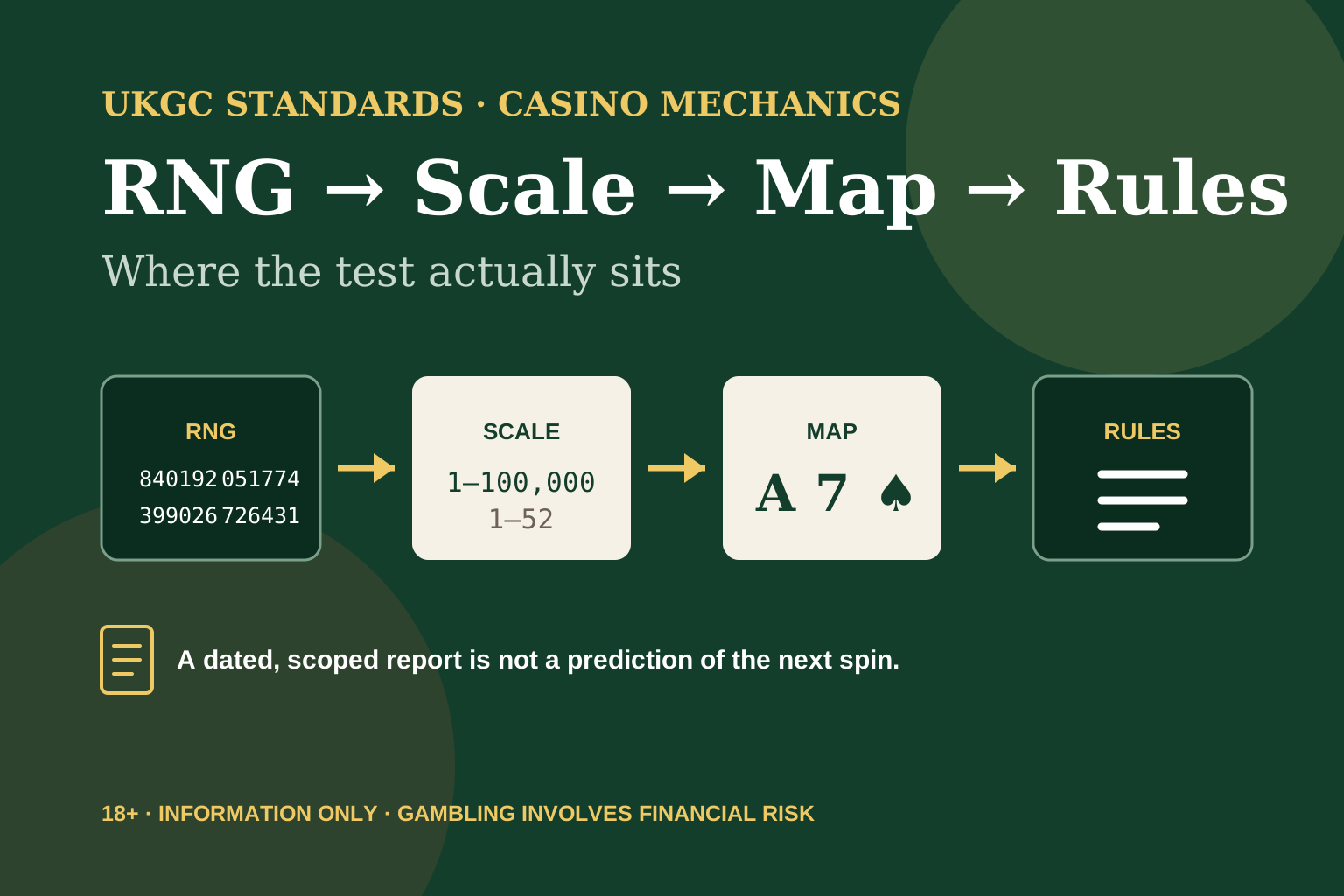
A report from a UKGC-approved test house is a dated, scoped compliance artefact confirming that statistical and rule-based criteria were met at a point in time; it does not predict outcomes, guarantee sessions, or remove loss risk.
The technical problem: four layers between seed and payout
The core technical problem in casino game design is that a raw random number generator produces a stream of integers with no inherent meaning. A value of 47,291 is not a card, a reel position, or a win. Between that raw output and the player-facing result sit at least three further transformations — scaling, mapping, and the application of published game rules — each of which can introduce or conceal a defect. Conflating these layers is the most common source of confusion when readers interpret a test report.
The UKGC's definition of terms draws the distinction explicitly. An RNG is hardware or software used to generate numbers with the intended property of statistical randomness. Scaling converts that output into the format a product requires — the standard's own example maps a 1–100,000 range down to 1–52 for a card deck. Mapping then selects a specific outcome from the scaled range, such as assigning a reel-strip symbol. Seeding determines the initial state of the generator. A compensated game, which adjusts the likelihood of winning outcomes according to previous payouts or intake, is a separate design choice that the standards address directly.
- Raw RNG output: a sequence of integers with a stated distribution, typically uniform over a defined range.
- Scaling: arithmetic conversion of that range to the product's working range (e.g., 1–100,000 → 1–52).
- Mapping: selection of a discrete outcome (symbol, card, number) from the scaled value.
- Game rules and pay table: the final layer determining whether a mapped outcome is a win, its value, and any bonus triggers.
UKGC scope: what the standards actually require
The Remote Gambling and Software Technical Standards (RTS) apply to remote gambling operators licensed in Great Britain. They do not, by their own terms, govern every jurisdiction; a test house operating under a different regulator may apply different criteria. The RTS 7 – Generation of random outcomes page was last updated 7 May 2024, and the testing strategy – approach was last updated 31 October 2025. Readers should treat any claim about casino RNG testing as scoped to the regulator and date stated in the report.
Under RTS 7A, random number generation and game results must be acceptably random, demonstrable to a high degree of confidence by generally accepted statistical analysis; adaptive or compensated behaviour is not permitted. The guidance adds that RNG output should be uniformly distributed over its output range, game outcomes should follow expected or theoretical probabilities, output should be unpredictable, cycles and synchronisation should be avoided, and seeding and scaling must not introduce predictability. RTS 7B requires that games follow their published rules and that mapping accords with prevailing probabilities and pay tables. RTS 7C prohibits misleading designs such as substituted near misses and requires simulated physical-device probabilities to match the real device.
- RTS 7A: statistical randomness of the RNG and its outputs; no adaptive or compensated behaviour permitted.
- RTS 7B: game rules, mapping, and pay-table compliance verified through maths, source-code, and game-play analysis.
- RTS 7C: prohibition of misleading design (e.g., substituted near misses); simulated devices must match real-device probabilities.
- An approved third-party test house performs pre-release statistical analysis of the RNG and outputs, including scaling and mapping where these fall within the RNG's scope.
- For 7B, 7C, 7E and specified jackpot requirements, the test house uses maths verification, source-code analysis, and game play.
What a report can and cannot establish
A test report is a dated, scoped document. The testing strategy – procedure for testing (last updated 13 September 2024) specifies that RNG reports identify the test house, licensee, date, certificate reference, RNG version and signature, scope, platform, limitations, and results. Game reports add the game name, RTP, software number and signature, test scope and approach, platform and channels, result, and any superseded versions. New games and RNGs can be released only after testing is complete and the report has been provided to the Commission. Integration changes and some major updates can require further testing.
What a report does not do is predict the next spin, guarantee a particular session's result, or remove the financial risk of gambling. A statistical test assesses whether a sample is consistent with a stated distribution; it does not eliminate variance. To make that concrete, consider an editorial calculation (not a certification test and not a model of every casino game): for a toy independent uniform six-outcome process observed over 60 trials, the expected count for any single outcome is E[X] = np = 60 × 1/6 = 10, and the standard deviation is √(np(1−p)) = √(60 × 1/6 × 5/6) ≈ 2.89. Observing a count of 7 is (7 − 10) / 2.89 ≈ 1.04 standard deviations below expectation. That deviation is well within the range of ordinary sampling noise and cannot, by itself, establish bias. A real casino game's outcome distribution is further shaped by scaling, mapping, and pay-table structure, so the arithmetic is illustrative only.
- A report confirms that, at a stated date and under stated conditions, the tested RNG or game met the applicable RTS criteria.
- It does not certify that the next outcome will be any particular value.
- It does not guarantee a player's session result or eliminate loss risk.
- It is scoped to a specific RNG version, game build, platform, and channel; a later update may require re-testing.
- The report is a compliance artefact, not a consumer guarantee of entertainment value or financial outcome.
Reading a report: scope, date, and practical checks
When a report is made available, the first task is to confirm scope. Check that the certificate reference, RNG or software version, and signature match the product you are examining. Note the date: a report that predates a major update may no longer reflect the live build. The testing strategy – procedure for testing notes that integration changes and some major updates can require further testing, so a pass on an earlier version does not automatically carry forward.
Understanding the relationship between the RNG layer and the game layer helps you read the report correctly. If scaling and mapping are included within the RNG's scope, the statistical analysis covers them; if they sit outside, the game-level maths verification under RTS 7B is the relevant check. The theoretical RTP stated in a game report is a long-run expectation derived from the pay table and mapping; it is not a promise of short-term returns. For context on how RTP and house edge interact with player experience, see RTP and house edge, and for how variance shapes session-to-session swings, see slot volatility and variance.
- Verify the report's date, version, and signature against the live product before drawing any conclusion.
- Confirm whether scaling and mapping fall inside or outside the RNG test scope.
- Read the stated limitations, platform, and channel; a report scoped to one platform does not automatically cover another.
- Treat the theoretical RTP as a long-run mathematical expectation, not a prediction of any individual session.
- Note that the RTS apply to Great Britain-licensed remote operators; do not assume the same framework governs a different jurisdiction.
Claim a reader might make: Comparison
| Claim a reader might make | Evidence the report actually checks | What the report does not establish |
|---|---|---|
| "The RNG is random." | Statistical analysis of raw output, scaling, and mapping under RTS 7A; source-code and documentation review. | That the next value will be any particular number; that variance is eliminated. |
| "The game follows its rules." | Maths verification, source-code analysis, and game-play testing under RTS 7B/7C. | That a specific session will produce a win; that the design is free of all ambiguity. |
| "The product is certified." | A dated, scoped test result provided to the Commission before release. | A permanent, jurisdiction-wide guarantee; a consumer warranty of outcome. |
Practical checklist
- Confirm the report's date, certificate reference, RNG/software version, and digital signature match the product you are examining.
- Check whether scaling and mapping are included within the RNG test scope or assessed separately under game-level testing.
- Read the stated limitations, platform, and channel; a report scoped to one platform does not automatically cover another.
- Treat the theoretical RTP as a long-run expectation derived from the pay table; it is not a prediction of any individual session.
- Note that the RTS apply to Great Britain-licensed remote operators; do not assume the same framework governs a different jurisdiction.
Sources and further reading
Fact-checked: . External sources open in a new tab.
- RTS 7 – Generation of random outcomesUK Gambling Commission
- 2 – Definition of termsUK Gambling Commission
- Testing strategy – ApproachUK Gambling Commission
- Testing strategy – Procedure for testingUK Gambling Commission