Independent guide · Casino
How Slot Machines Work: From Lever to Online Slot
How reels, RNG and paytables determine slot outcomes. Calculate RTP, hit frequency and short-session risk with a transparent 1,000-outcome model.
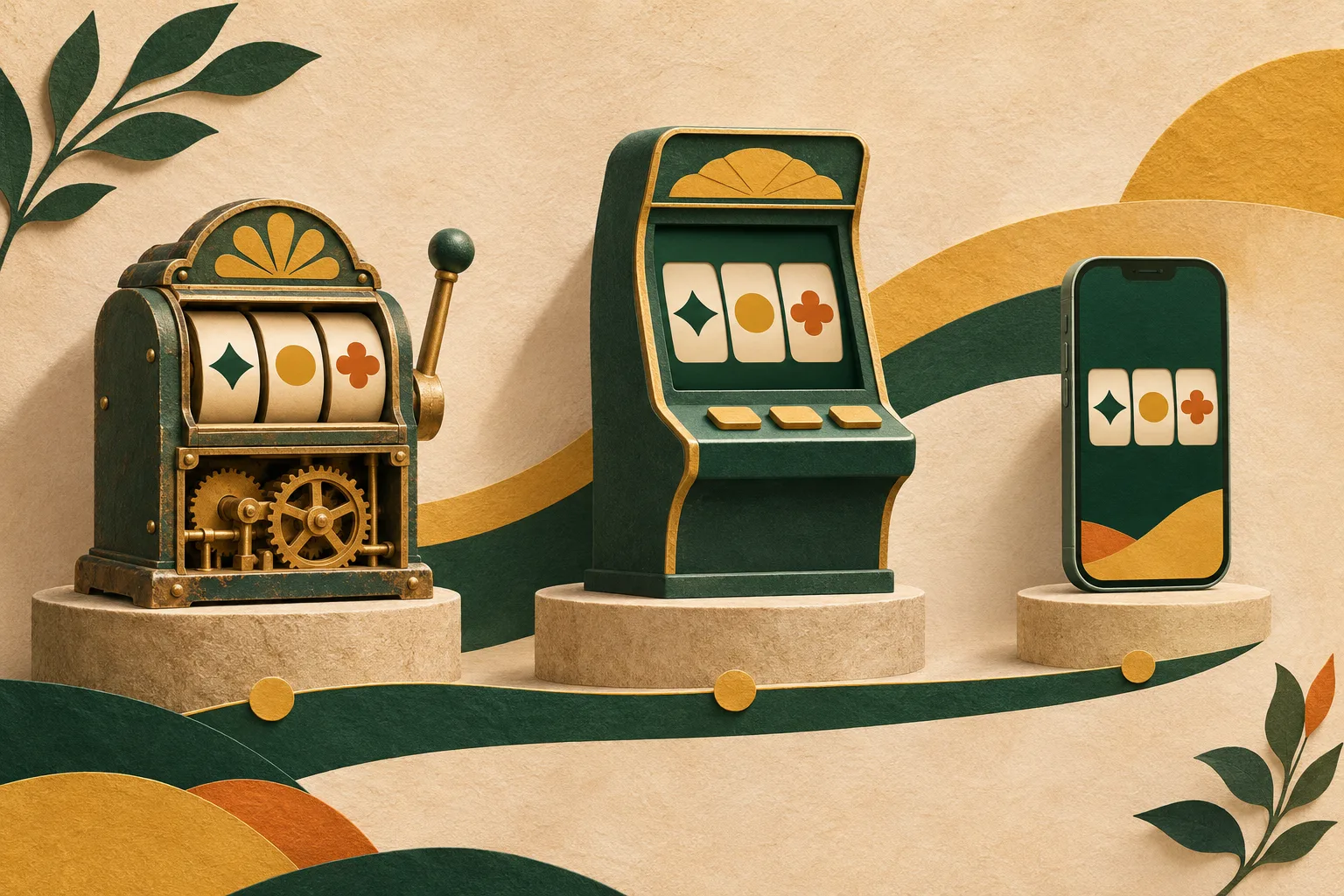
Slot machines determine outcomes through specific mechanisms and rules, then match those results against a paytable. In older mechanical devices, physical reels played a direct role in this process; in electronic slots, the result is tied to software and a random number generator (RNG). The external similarity between these devices is deceptive: you cannot reconstruct their probabilities simply by looking at three images in a window.
Quick Overview. Below, we compare three generations of slot machines, trace the path from stake to payout, and build our own model using just 1,000 combinations. This model demonstrates how a slot can have a Return to Player (RTP) of 90%, even though a large prize almost never appears during a short session. We will also examine an exception: some land-based machines use compensatory mechanisms, meaning the phrase “all slots are built the same way” is incorrect.
Author: Dmitry Yakushev. Reviewed on 10 November 2026. Educational material for adults; examples are hypothetical.
Original conceptual illustration by WinWinWin, created using AI. This compares the form of the devices, not a blueprint of their internal workings.
What Changed from the One-Armed Bandit to the Online Slot?
The lever, the reels, and the small window with symbols have outlived the technology for which they were originally designed. Historical machines from the late 19th century can be seen in the SFO Museum collection, including the three-reel Liberty Bell by Charles Fey. The museum exhibit allows us to trace the transition to automatic payouts, but it does not describe the mechanics of modern online games. SFO Museum Collection, 2016–2017 Exhibition; verified 10.11.2026.
For the reader, it is more useful to categorize machines by how they determine the result rather than by the presence of a physical lever.
| Variant | What to Distinguish | What Cannot Be Concluded from Appearance |
|---|---|---|
| Historical Mechanical Slot | Physical reels, their positions, stopping mechanisms, and payout hardware | That every drawn symbol has an equal probability |
| Electronic Land-Based Slot | Software mathematics and the display mechanism | That real reels necessarily imply a purely mechanical selection |
| Online Slot | Game logic, payout rules, and interface visuals | That visible spinning reveals the internal probability table |
This is a comparison scheme, not a universal legal classification of equipment. Device categories and requirements depend on the country. Even within a single jurisdiction, different types of land-based machines may exist.
The word “electronic” does not answer all questions either. A machine may display physical reels while electronically controlling their stopping positions. Conversely, a game on a screen may mimic the look of a physical machine that is technically structured differently.
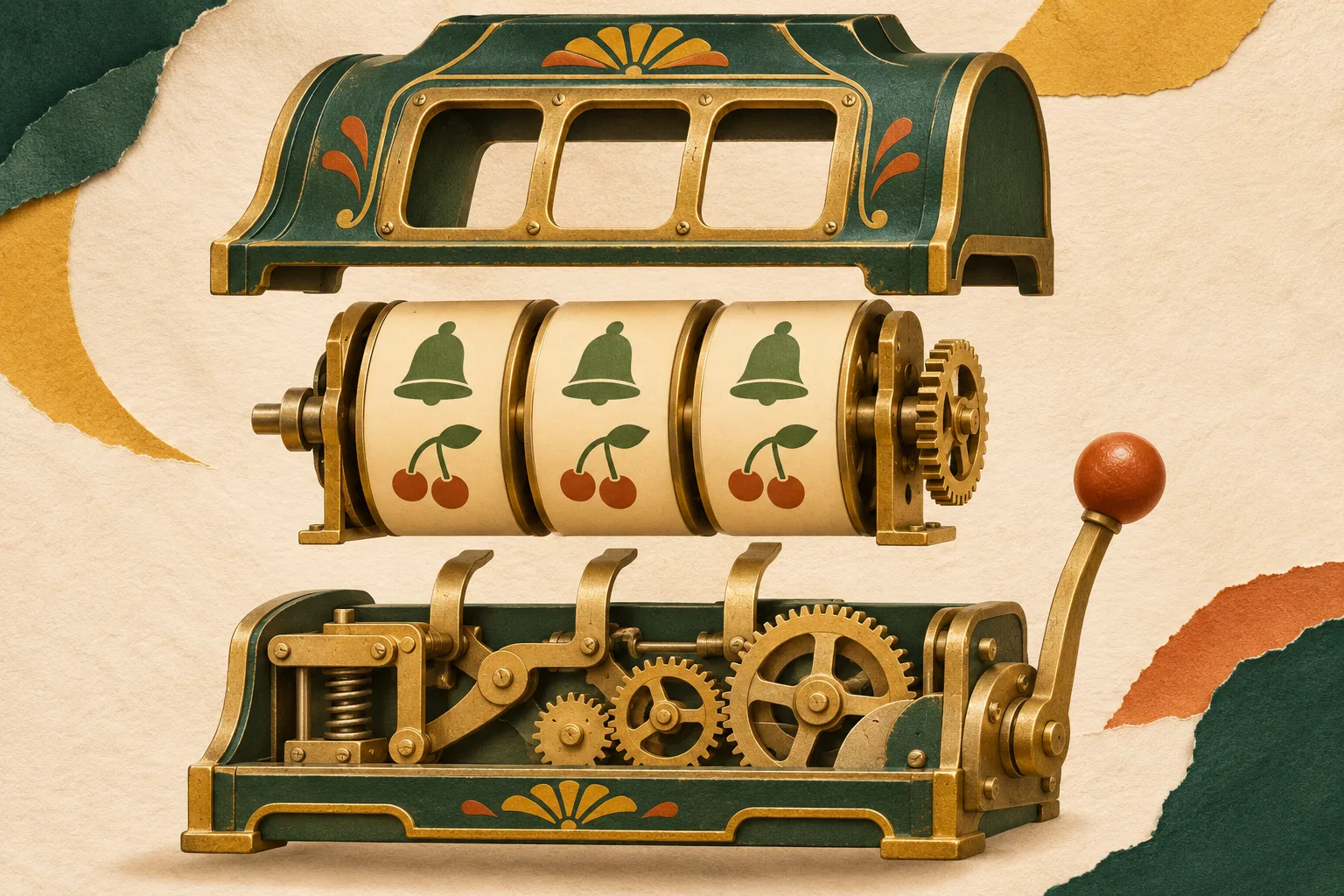
Zoomed-in conceptual view of details. The image was created using AI and is not intended for repairing or assembling a machine.
Why a Physical Reel Does Not Reveal the Odds
Imagine a wheel with twenty marks. It seems natural to assume that each mark has a 1 in 20 chance of being selected. However, this is only true under an additional condition: the mechanism must actually select all twenty positions with equal probability. The picture on the casing does not prove this condition.
A technical example of this distinction is found in US Patent US4448419A, published on 15 May 1984. The described device links numbers to reel stopping positions; one stopping position can be assigned to several selected numbers. This allows probabilities to change without altering the physical reels themselves. This is a specific patented solution, not a description of every slot on the market. Patent Inge S. Telnaes, US4448419A, 15.05.1984; verified 10.11.2026.
Let’s take a separate hypothetical example. A program selects one of ten equally likely numbers. Seven numbers correspond to a blank field, two to a cherry, and one to a bell. The probabilities are then 70%, 20%, and 10%, respectively. Three types of images do not translate into three equally likely outcomes.
Now, let’s change only the mapping: nine numbers lead to a blank field, and one leads to a bell. The set of visible symbol types is almost the same, but the distribution is different. Therefore, counting pictures in a promotional video does not replace information about the game’s mathematics.

We separate the physical construction, the result selection, and its display. The illustration is artistic: lines and gears do not denote real electrical connections.
What Happens Between Pressing the Button and the Payout?
To understand electronic games, it is helpful to consider four distinct tasks: accepting a valid stake, generating a random value, converting that value into a game outcome, and calculating the payout according to the rules. This is an explanatory model of the process, not a claim that all manufacturers use the same architecture.
A random value is not yet a win. It is crucial how the program converts the value into symbols and events. If the source numbers are uniform, but several numbers correspond to a single symbol, the symbol distribution will be uneven. This is a fundamental error to avoid: “random” does not mean “all pictures appear with equal frequency.”
The paytable completes the calculation. You need to know which combinations are paid, which stake the multiplier applies to, and what additional conditions apply. Without this, even precise knowledge of a single symbol’s probability does not yield the game’s overall RTP.
The display must match the result. For remote games falling under the UK’s Remote Technical Standards, Section RTS 7 requires acceptable randomness and consistency of outcomes with stated rules and probabilities. It also prohibits adaptive compensation and specifically addresses misleading displays, including replacing a loss with an artificial “near miss.” These are requirements of a specific regulator, not a confirmation that any site complies with them. UK Gambling Commission, RTS 7; verified 10.11.2026 against the indexed official text.
Details on RNG testing are covered in our article on Randomness and RNG Testing. Here, the order of reasoning is key: first the outcome model, then the payment rules, and only then the visual representation seen by the player.
How to Get 90% RTP from 1,000 Combinations?
Let’s build our own educational slot. This is not a real product and not an assessment of any casino. Its simplicity is necessary so that every number can be verified without access to a developer’s closed documentation.
It has three independent reels, each with ten equally likely positions. On each reel, there is one bell, two cherries, and seven blank positions. There is one payline. A spin costs one abstract monetary unit. There are no bonuses, jackpots, or other payouts.
Three bells return 500 units, and three cherries return 50. Payouts here denote the total return, including the staked unit, not the net profit above the stake. The net result for these two outcomes is +499 and +49 units, respectively.
The total number of equally likely position combinations is:
10 × 10 × 10 = 1,000.
| Outcome | Number of Position Combinations | Probability | Total Return for This Outcome |
|---|---|---|---|
| Three Bells | 1 × 1 × 1 = 1 | 0.1% | 500 |
| Three Cherries | 2 × 2 × 2 = 8 | 0.8% | 50 |
| All Other Combinations | 991 | 99.1% | 0 |
It is easy to confuse symbols with positions here. A cherry looks identical on both its positions, but each reel has two ways to stop on it. Therefore, the combination of three cherries is represented by eight triples of positions, not just one.
If we sum the payouts across all 1,000 possible combinations, we get:
1 × 500 + 8 × 50 + 991 × 0 = 900.
For every unit staked, the mathematical expectation of the total return is 900 / 1,000 = 0.9. Thus, the model’s RTP is 90%, and the expected net result of a single stake is 0.9 − 1 = −0.1 units.
This is a full enumeration of possible combinations. It does not mean that in 1,000 real spins, each combination will appear exactly once. In independent random trials, some outcomes may repeat, while others may not appear at all.
It is useful to check the probability balance: 0.1% + 0.8% + 99.1% = 100%. If the sum does not match, an outcome is missing from the model, or one category has been counted twice.
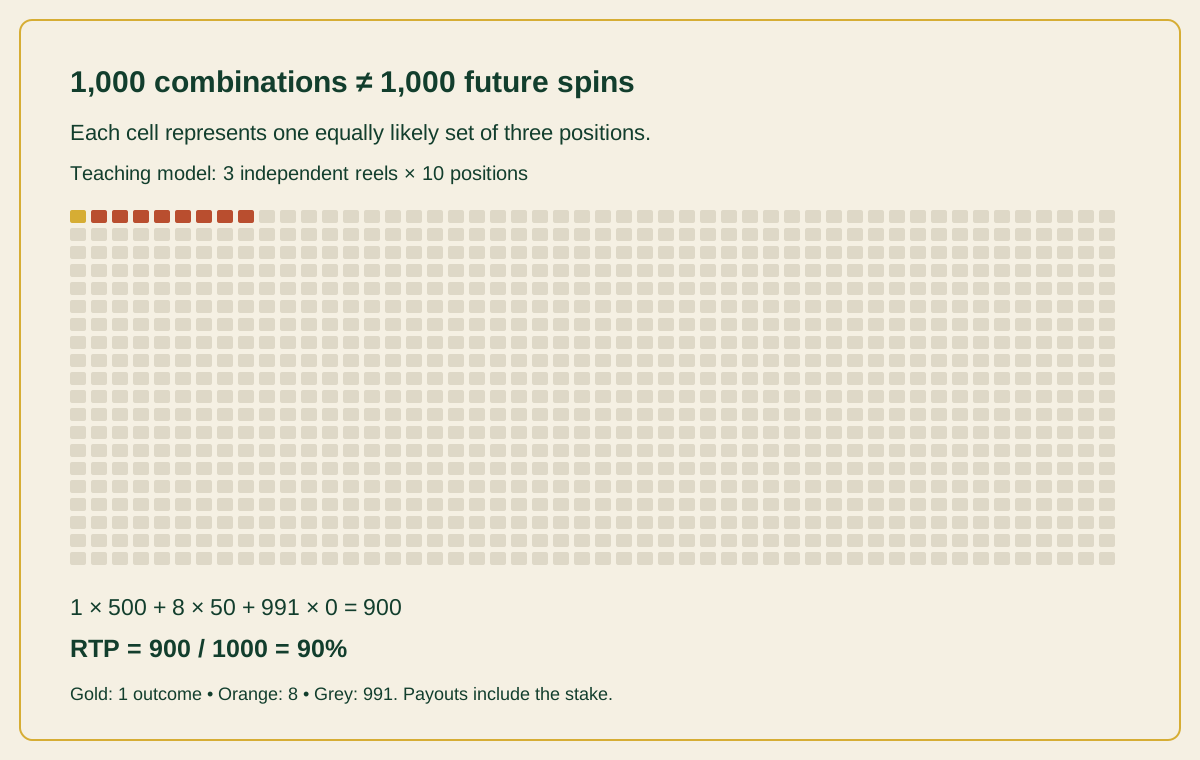
The scheme is built based on a full enumeration of our model. Cells denote possible outcomes, not a schedule of spins.
Why RTP Does Not Promise a Return in One Evening
In our model, the large prize has a probability of 0.001 on each spin. The probability of not seeing it in 100 independent spins is:
(1 − 0.001)¹⁰⁰ = 0.999¹⁰⁰ ≈ 90.48%.
Therefore, the absence of such a prize in one hundred spins is fully compatible with the defined mathematics. The figure 90.48% refers specifically to the absence of three bells. It is not the probability of ending the session at a loss: that would require accounting for cherry payouts as well.
With a fixed program of 100 spins at one unit each, the total wagered turnover is 100. The expected return is 90, and the expected loss is 10. The actual result may differ significantly. The additional condition of a “fixed program” is substantial: stopping after a certain win or running out of funds changes the description of the session.
The UK Gambling Commission explicitly explains RTP as an average over a large number of games, not a promise of return in a specific session. The page also distinguishes between random and compensatory machines. UKGC, Return to Player, updated 16.06.2021; verified 10.11.2026.
You can verify the arithmetic using our RTP Loss Calculator: stake per round — 1, number of rounds — 100, RTP — 90%. The calculation yields a turnover of 100, expected payouts of 90, and an expected loss of 10. The calculator applies a formula; it does not model the sequence of specific wins or predict a balance.
It is important to calculate turnover, not just the initial deposit. If the same returned amount is staked again, it re-enters the wagered turnover. Therefore, the size of the deposit alone is insufficient for calculating expected losses.
Can Two Slots with the Same RTP Behave Differently?
Even our educational mathematics shows why a single percentage is not enough. The first machine returns money in nine combinations out of a thousand: the frequency of any non-zero payout is 0.9%.
Now, let’s build another hypothetical model: one thousand equally likely tickets, of which 450 return two units each, and the rest return nothing. With a ticket price of one unit, the expected return is again 450 × 2 / 1,000 = 0.9. The RTP is the same, but the payout frequency is now 45%.
This is a comparison of two distributions, not a description of an existing slot’s hardware. It proves a limited point: the same average does not determine how frequently and in what amounts payouts occur. You cannot declare two games identical just because their RTPs match.
For further reading on this topic, see our breakdown of Slot Hit Frequency. You should not try to derive frequency by dividing RTP by an arbitrary number: you need the probabilities and sizes of individual payouts.
Can Past Results Influence Future Ones?
The answer depends on the type of device. In our independent model, the chance of three bells is always 0.1%, regardless of the previous hundred results. There is no counter in the model that makes bells “due” after a series of losses.
However, this statement cannot be transferred to all land-based machines. The UK regulator separately describes compensatory machines: feedback from previous results can change probabilities or prize sizes to influence the return. There remains an element of randomness; this is not a schedule of guaranteed payouts. This explanation applies to specific land-based devices in the UK. UKGC, Technical Clarification in the August 2020 Bulletin; verified 10.11.2026.
For remote games regulated by the aforementioned RTS 7, adaptive compensation is prohibited. You cannot take the description of a British compensatory machine and present it as an explanation for any online slot. Requirements in other jurisdictions must be checked separately: the British standard is not a universal rule.
The practical conclusion here is investigative: before assessing a specific device, you must determine its category and applicable rules. The words “slot” or “one-armed bandit” are too broad to derive a precise algorithm from them.
Why a Payout Can Still Be a Loss
A hypothetical round costs one unit. The screen displays a payout of 0.30. There is a return, but the net result is 0.30 − 1 = −0.70. You cannot record such a round as profitable just because the interface marked it with sound or animation.
A research review by the Australian Institute of Family Studies examines such losses, formatted as wins, among the features of electronic gaming machines. This is a 2017 review, primarily in the context of Australian EGMs, not a fresh experiment on all mobile slots. Charles Livingstone, How electronic gambling machines work, 11.07.2017; verified 10.11.2026.
Therefore, when recording results, you need at least three separate values: the deducted stake, the total return, and the net change in balance. The external interface signal does not replace the last column.
A similar trap arises with the “near miss.” Two matching symbols out of three may look convincing, but they do not communicate the probability of the next result. In our model, after such an outcome, the distribution of the next spin remains unchanged. For another game, you must first read its rules, including paid combinations and special features.
What Errors Prevent Understanding How Slots Work?
Assuming every symbol type is equally likely. Two identical pictures may correspond to a different number of internal positions. Our example with two cherries shows how this affects even a simple combination.
Mixing total return and profit. A payout of 50 on a stake of 1 yields a net result of +49. When calculating RTP, the total return is used; when assessing the change in money, the stake must be deducted.
Treating theoretical enumeration as a schedule for future spins. A thousand possible combinations does not mean a thousand steps after which the machine must cycle through the entire list.
Drawing conclusions about rules from a short screen recording. It shows observed outcomes but does not prove the full set of possible results, their probabilities, or compliance with technical standards.
Confusing knowledge of mechanics with a way to earn. The ability to calculate a negative mathematical expectation does not change its sign. A longer game does not, in itself, turn a losing model into a winning one.
What to Check in the Rules of a Specific Game?
Before making any conclusions, find the exact name of the game, its developer, and an identifiable version of the rules. If this information cannot be obtained, there is insufficient data to attribute specific characteristics to the game.
Next, check what the stated stake applies to: the entire round or a specific line. Read the conditions for paid combinations and the definitions of multipliers. Separately list any bonus features, if present: our simple model does not include them and cannot replace their calculation.
Find the stated RTP specifically in the available game documentation. If there are multiple values, you need to understand the conditions for each, rather than choosing the highest one from a promotional description. Do not substitute a number from a review of another version without confirming compatibility.
For a land-based machine, clarify the category and jurisdiction. For an online service, verify the stated license in the official registry of the relevant regulator. A logo on a website is not independent proof. This article does not verify individual platforms or recommend operators.
If the goal is to analyze a disputed round, save the game and round identifiers, the time, the stake size, the credited return, and the available rules. Such details are more useful than the phrase “it almost matched on the screen.”
The risk that calculation does not remove. In the model provided, each additional spin adds an expected loss. Attempting to recoup a previous loss increases new turnover without canceling the prior result. If explaining the device turns into searching for a “moment when it must pay out,” it is better to stop playing than to complicate the strategy.
Frequently Asked Questions About Slot Machine Operation
Are there real reels inside an online slot?
The visible reels are an image in the interface. To understand probabilities, you need the rules for converting random values into outcomes, not an assessment of spinning speed. You cannot reconstruct a closed mathematical model from a single animation.
Can a slot go a long time without paying out the main prize?
In our hypothetical independent model, the probability of not getting a combination with a 0.1% chance in one hundred spins is approximately 90.48%. This is a calculation for defined conditions, not statistics for a real slot. The absence of a rare outcome alone does not prove a rule violation.
Does 96% RTP mean a return of 96 out of every 100?
No: this is the average theoretical return relative to the wagered turnover, not a mandatory result for a specific hundred spins. For a hypothetical turnover of 100, the expectation would be 96, but the actual result may differ. The size of the initial deposit is not equal to the turnover if funds are re-staked.
Can you tell if a slot is mechanical by looking at the lever?
The presence of a lever does not reveal how reel positions are selected. The patent example above shows that electronic control can be combined with physical reels. Documentation for the specific device is required.
Must a slot compensate for past losses?
For an independent model, there is no such obligation. Some British land-based compensatory machines represent a separate mechanism, but even they do not promise compensation to a specific individual. Transferring this description to remote games regulated by RTS 7 is incorrect.
To check if you understand the mechanics, try modifying our table yourself: reduce the payout for three bells from 500 to 400, keeping all other conditions the same. The expected return becomes (400 + 8 × 50) / 1,000 = 80%. The symbols and their frequency of appearance have not changed, but the RTP has dropped by ten percentage points. This is why the game’s structure must be read in full: probabilities without a paytable provide only half the answer.