Independent guide · Crypto
Bitcoin: Money Without a Central Authority
How Bitcoin changes payment verification, control over funds and responsibility for mistakes—and what to check before a transfer.
Why this matters
Bitcoin moves verification away from a single institution. It does not remove risk: control over spending and responsibility for recovery still sit somewhere.
The influence is a change in who can check the money
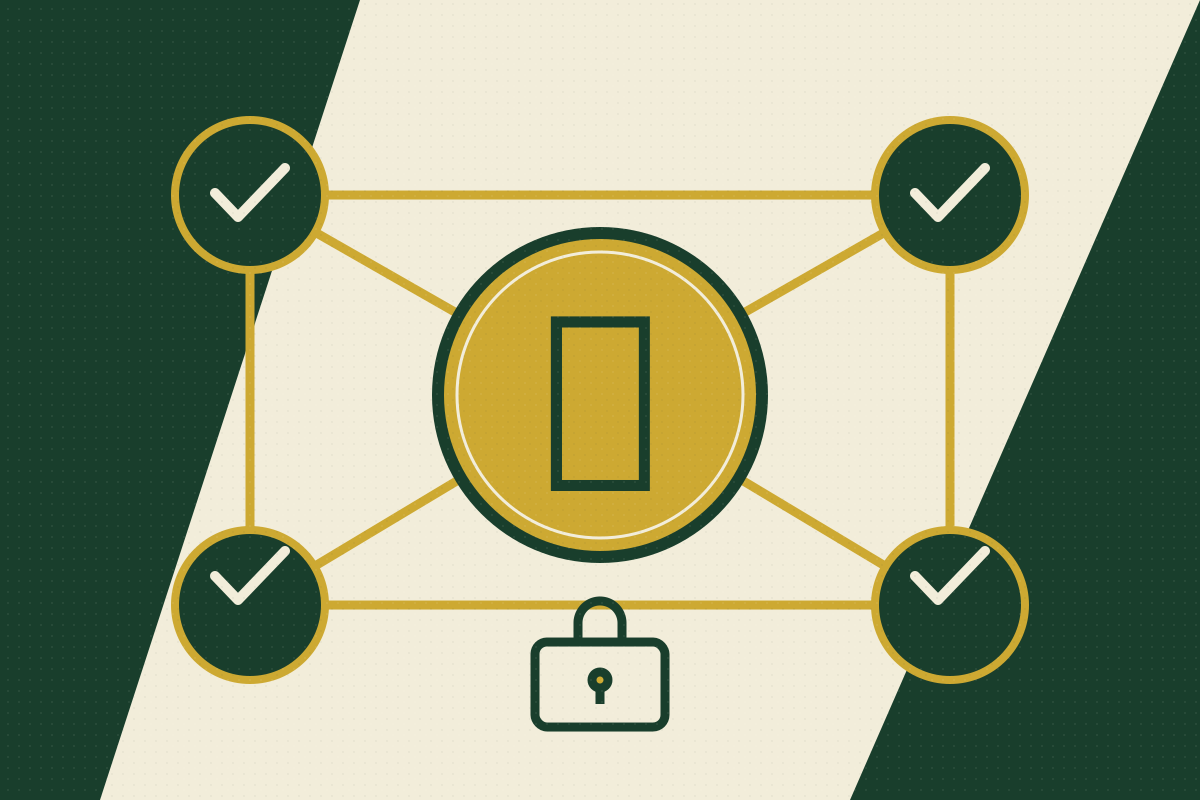
Bitcoin changes control over money by allowing full nodes to check transfers against shared rules without a single institution approving the ledger. That is its practical influence—not a promise that its price will rise. For a reader, three questions follow: who verifies a payment, who can authorise spending and who bears the cost of a mistake?
The original white paper describes electronic cash without a trusted third party to prevent double-spending. Its security argument depends on assumptions about honest computing power relative to attackers; it is not an unconditional guarantee. Removing a central approver also removes the expectation that one central office can correct every payment. Those two consequences belong in the same discussion.
Nodes check the rules; miners order valid transactions
Full nodes independently validate the blocks and transactions they receive. They check, among other things, whether the referenced outputs can be spent and whether the spending conditions are satisfied. A valid chain cannot spend the same output twice. This does not mean every node sees the same unconfirmed transactions at the same instant.
Miners assemble candidate blocks and perform proof-of-work. Their role helps establish transaction ordering. Finding a qualifying hash does not excuse invalid contents: nodes still validate the proposed block. Verification and mining are related jobs, not interchangeable names for one authority. The reader gains a way to verify the ledger, not a guarantee that every attempted transfer will be included promptly.
A balance is not the same thing as spending control
On-chain bitcoin is represented through unspent transaction outputs. A new transaction references previous outputs and must satisfy their spending conditions, typically using signatures produced with private keys. A wallet’s displayed balance is a convenient view of funds; the ability to spend them depends on the required keys and conditions, which can include more than one signature.
With self-custody, the holder takes responsibility for key protection and a usable recovery method. With a custodial service, the displayed account balance depends on an operator’s records and withdrawal process. An operator’s support team is not a Bitcoin protocol recovery service. Neither arrangement makes all risks disappear; they place control and dependencies in different hands.
- Verification: a full node can check protocol validity; an account display alone does not show who controls the required keys.
- Spending: self-custody depends on meeting the output’s conditions; custodial withdrawals also depend on the operator.
- Recovery: a valid backup can restore access to required keys; it cannot reverse a payment already sent to another party.
- Responsibility: an operator introduces counterparty risk, while self-custody puts key-security and recovery duties on the holder.
Public verification does not mean anonymity
Bitcoin’s transaction history is public. An address is not itself a person’s name, but transactions can be linked to identities through information outside the chain. Bitcoin.org warns that Bitcoin is not anonymous and that transaction information is public and permanently recorded. A reader should not confuse the absence of a central account issuer with the absence of a visible payment trail.
This matters when choosing what to disclose. Publishing a payment address can link an activity to public transaction data. The editorial distinction is simple: being able to inspect a ledger and keeping personal financial information private are separate goals. Neither a familiar wallet interface nor a new address is, by itself, a complete privacy assurance.
Broadcast is not settlement
A broadcast transaction may be held in nodes’ pools of unconfirmed transactions before inclusion in a block. Inclusion gives the first confirmation; subsequent blocks building on it add confirmations. An unconfirmed transaction may conflict with another transaction or be replaced under applicable policies. A notification saying ‘sent’ is therefore not the same as an accepted, confirmed payment.
Further confirmations reduce some risks, but chain reorganisation risk is not zero. There is no universal confirmation threshold suitable for every recipient and amount. Fees influence inclusion incentives, not a guaranteed delivery time. Before paying, check the recipient’s confirmation policy and understand that a pending transaction can remain pending longer than the interface initially suggests.
A valid payment can still be the wrong payment
Consider a hypothetical sender paying a merchant. The sender’s wallet constructs and signs a transaction. Nodes validate it, a miner includes it in a valid block and the merchant waits according to an appropriate confirmation policy. This is a simplified illustration, not a reported transaction or a claim that every wallet follows an identical process.
Now change one detail: the sender copied a different valid destination address. The payment can satisfy the protocol’s rules while going somewhere the sender did not intend. This is not a claim that a one-character typo will pass an address checksum. It is a distinction between a valid destination and the intended destination.
There is no central Bitcoin authority that can reverse a confirmed transfer. A cooperative recipient can send a new refund transaction, but that is a separate action, not an undo button. If the destination is inaccessible or the recipient will not cooperate, recovery may not be possible. Rules validate spending authority; they do not read the sender’s intention.
The useful test is control, not the price chart
My editorial test for Bitcoin’s influence is practical: can a reader identify the rules being checked, the keys or operator controlling spending and the recovery path before sending? That test is more useful than declaring the end of banks or predicting a price. A system can make verification more accessible while demanding more care from the person using it.
Start with the checklist below. Bitcoin.org recommends securing wallets and maintaining backups; encryption alone does not address every threat. Do not share recovery secrets with someone claiming to be support. If you cannot explain who controls the funds or how access would be recovered, resolve that uncertainty before making an irreversible transfer.
Practical checklist
- Confirm the intended destination through a reliable channel, not merely that the address is syntactically valid.
- Identify who holds the required keys and whether a withdrawal depends on a custodial operator.
- Check fees and the recipient’s confirmation policy; neither broadcast nor one confirmation is a universal settlement guarantee.
- Maintain a secure, usable backup and recovery plan appropriate to the wallet; never disclose private keys or recovery secrets to support callers.
- Account for the public transaction trail and avoid assuming Bitcoin is anonymous.
- Pause if the destination, spending control or recovery process remains unclear.
Sources and further reading
Fact-checked: . External sources open in a new tab.
- Bitcoin: A Peer-to-Peer Electronic Cash SystemSatoshi Nakamoto
- Block Chain — Developer GuideBitcoin Developer Guide
- Transactions — Developer GuideBitcoin Developer Guide
- Mining — Developer GuideBitcoin Developer Guide
- Payment Processing — Developer GuideBitcoin Developer Guide
- Securing your walletBitcoin.org
- Some things you need to knowBitcoin.org