Independent guide · Crypto
Hot wallets, cold wallets and custodial accounts: how they differ and what risks remain
Clear, evidence-led comparison of hot wallets, cold (hardware/offline) wallets and custodial accounts, their security trade-offs, and practical allocation guidance. Sources: CISA, Coinbase SEC filing, Ledger.
Why this matters
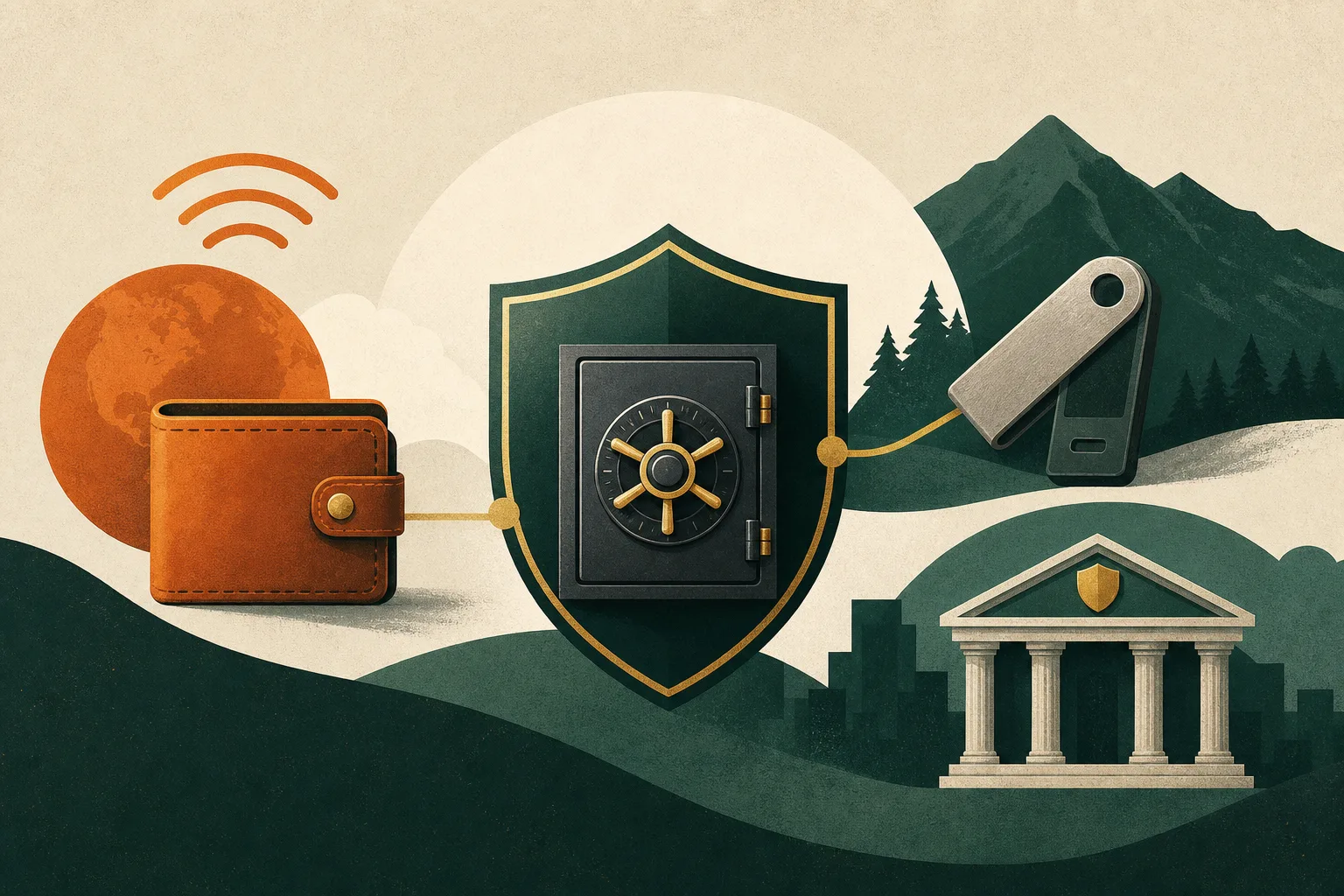
Hot wallets prioritise convenience and speed but expose keys to online threats; cold/hardware wallets reduce remote attack surface but require safe physical handling and backups; custodial accounts shift operational responsibility to a third party while introducing counterparty risk. No option is risk-free.
Definitions: what each storage type means
Hot wallet: a wallet whose private keys or signing capability are accessible from an internet-connected device or service. Examples include software wallets (mobile/desktop), browser extensions, and exchange-hosted accounts. Hot wallets enable fast on-chain activity but are exposed to online threats such as phishing, malware, and compromised web interfaces.
Cold wallet (offline/hardware): private keys are stored offline — on a hardware device, air-gapped computer, or paper/metal seed. Hardware wallets provide an isolated signer that keeps keys inside a secure element and displays transaction details on a secure screen. Cold storage reduces remote attack surface but transfers risk to physical security, supply-chain integrity and backup practices.
- Hot wallet = internet-accessible signing capability (fast, convenient).
- Cold wallet = offline key storage (reduced remote risk, needs physical security).
- Custodial account = third party holds private keys and operates hot/cold mixes.
Security trade-offs and common attack vectors
Hot wallets trade lower friction for higher exposure to online threats. CISA documents and incident compendia highlight phishing and social-engineering as frequent loss vectors; malware and exploited web-app vulnerabilities also lead to key theft or unauthorised transactions.
Cold/hardware wallets reduce the risk of remote compromise because keys never leave the device. However, attack vectors remain: physical theft, compromised supply chains (tampered devices), user errors when backing up or restoring seeds, and social-engineering attacks that trick users into revealing recovery data. Ledger vendor materials describe secure elements and on-device verification as mitigations, not absolute guarantees.
- Hot wallet threats: phishing, browser exploits, mobile malware, exchange hacks.
- Cold wallet threats: theft, lost/damaged devices, poor backup practices, supply-chain tampering.
- Custodial risks: insolvency, insider fraud, regulatory seizure, operational failures.
Custodial accounts: convenience vs counterparty risk
Custodial providers (exchanges, specialised custodians) hold private keys and operate mix of hot and cold storage to provide liquidity and settle customer withdrawals. Corporate disclosures (example: Coinbase SEC filing) explain operational segregation and controls, but they also make clear that users rely on the custodian to safeguard assets and that custody introduces counterparty risk.
Custodians may carry insurance or implement multi-signature and institutional processes; however, insurance policies often contain exclusions (insider fraud, bankruptcy) and cover limited amounts or conditions. Reading a provider’s public filings and terms is essential to understanding what protection is actually afforded.
- Custodial control simplifies user operations but adds counterparty exposure.
- Professional custody can use advanced controls and insurance, but coverage varies and exclusions exist.
- Users should verify custodian disclosures and understand withdrawal/security controls.
Practical allocation framework and worked example
A useful way to think about allocation is by role: immediate liquidity (spend/trade), near-term access (monthly/yearly), and long-term storage. Ask: total portfolio value, frequency of transactions, minimum acceptable immediate liquidity, technical comfort, and tolerance for counterparty risk.
Illustrative example: with a $50,000 portfolio and $2,000 immediate liquidity need you might hold $2,000 on an exchange or mobile wallet for fast access, $1,000 in a hot non-custodial wallet for daily use, and $47,000 in a hardware cold wallet with secure, geographically separated seed backups. This pattern minimises exposure while preserving access. It is not investment advice — adapt to your circumstances.
- Split by use-case: liquidity, near-term, long-term.
- Minimise hot balances to the amount you actually use.
- Keep long-term holdings offline with proper backups in multiple secure locations.
Practical checklist
- Decide how much you need for immediate liquidity and keep only that in hot wallets or exchanges.
- Buy hardware wallets from manufacturers or authorised resellers; verify packaging and firmware.
- Record recovery seeds securely (metal backups where possible) and store copies in separated physical locations.
- Enable strong account protections for custodial services: unique passwords, 2FA, withdrawal whitelists where available.
- Regularly review custodial disclosures and insurance statements before entrusting large balances.
- Practice phishing resistance: verify URLs, avoid unsolicited links, and confirm transaction details on-device for hardware wallets.
Sources and further reading
Fact-checked: . External sources open in a new tab.
- Compendium of Cybersecurity (CISA) — Tech investigationsU.S. Cybersecurity & Infrastructure Security Agency (CISA)
- Coinbase — Annual report (custody disclosures)SEC filing (Coinbase)
- Hot wallet vs cold wallet — Ledger AcademyLedger