Independent guide · Payments
M-Pesa History: How Mobile Money Worked Without Internet
From Kenya’s loan pilot to phone-based payments: trace M-Pesa’s history, agent cash, fees and the later move to smartphone apps.
M-Pesa let people send money using an ordinary mobile phone, without a smartphone or mobile internet connection. Launched in Kenya in 2007, it connected a phone-based wallet with shops that exchanged cash for electronic value. Its history is a story of practical infrastructure: a microfinance experiment, an unexpected demand for family transfers, and agents who made a digital balance spendable as cash. The calculations below show where fees and cash shortages enter that system, even when the technology works.
What problem did the first M-Pesa solve?
Imagine sending part of your wages to a relative who needs cash, not an app notification. A successful payment needs several things to happen: you must hand over value, identify the recipient, transmit an instruction and give that recipient a usable balance. If the relative needs banknotes, someone nearby must also have enough cash. A faster message solves only part of the problem.
M-Pesa joined these steps. The original customer could register for a wallet without opening a personal bank account, then exchange cash and electronic value through agents. The founding account by Nick Hughes and Susie Lonie describes that model in their 2007 paper. It is evidence about the early service, not a statement of today’s account-opening rules.
The distinction matters. “Without a personal bank account” does not mean “without banks anywhere in the system.” Nor does a simple phone menu mean that the infrastructure behind it is simple. The useful question is which tasks the customer no longer has to organise personally.
How did a loan-repayment pilot become a transfer service?
The starting idea was narrower than a general payments network. Tamara Cook’s FSD Kenya account, published on 12 August 2015, traces it to a UK development grant matched by Vodafone and a Kenyan partnership involving Safaricom, a microfinance institution and a bank. A pilot began in late 2005 to test mobile loan repayments.
Cook describes a different use emerging: participants wanted to send money between people. Michael Joseph’s 2017 Vodafone retrospective also describes the importance of sending money from urban workers to relatives elsewhere. These are accounts from organisations involved in the project. They explain the design decisions; they are not independent proof that every household benefited equally.
The commercial proposition became easier to understand: send money to another person, rather than learn a new technology for its own sake. The lesson is practical. A product can begin with a provider’s preferred workflow and become useful through a task its users already need to complete.
Which dates explain the change from basic phones to apps?
| Period | Documented development | What it helps explain |
|---|---|---|
| Late 2005–2006 | Pilot and development before commercial launch | M-Pesa was tested and adapted before becoming a public transfer service |
| 6 March 2007 | Kenyan commercial launch | The service began in the feature-phone era |
| April 2015 | Infrastructure moved to Kenya, according to Joseph’s retrospective | Customer-facing simplicity depended on substantial technical operations |
| 2021 | M-Pesa SuperApp launched, according to Vodafone’s 2022 anniversary account | Smartphone access came much later than the original service |
The exact launch date and the 2021 app milestone come from Vodafone’s fifteenth-anniversary account, published in 2022. The table is a selected chronology, not a claim to cover every market, ownership change or product release.
It is tempting to tell this as a story of an app that became popular. That reverses the sequence. The money-transfer service existed before its smartphone interface. A useful way to read the timeline is to separate the payment system, the way customers accessed it, and the network of people who supplied cash.
Did M-Pesa really work without the internet?
The original service did not require the customer to buy mobile data or use a web browser. The founding paper describes a SIM-based menu and SMS messaging. Vodafone’s anniversary account places the launch on 2G networks and ordinary phones. “No mobile internet required” is the precise description. “No network required” is wrong.
Think of three layers. The phone gives the user an interface. The mobile network carries instructions. The payment system records balances and transfers. A basic handset can provide the first layer without displaying a modern banking app. That does not make the other layers disappear.
This also avoids a misleading national claim. The fact that a service did not require internet access on the customer’s phone does not establish that Kenya had no internet. It tells us about the access requirements of this particular service. The practical achievement was meeting users where their available technology already was.
What does the agent actually exchange?
An agent is the bridge between cash and wallet value. FSD Kenya’s 2015 explanation describes deposits and withdrawals at retail outlets, with agents paid by Safaricom for performing those exchanges. A customer handing over cash receives wallet value; a customer withdrawing cash gives up wallet value. This is a historical description of the mechanism, not a current agent contract.
The following is an original teaching ledger. It ignores fees and assumes a deposit of KES 1,000 is completed successfully. These are invented inputs for arithmetic, not observed balances or operating requirements.
| Position | Agent’s cash | Agent’s electronic float | Customer’s added wallet value |
|---|---|---|---|
| Before deposit | KES 3,000 | KES 2,000 | KES 0 |
| After KES 1,000 deposit | KES 4,000 | KES 1,000 | KES 1,000 |
The agent now has more banknotes but less electronic value available for further deposits. A withdrawal moves those two agent balances in the opposite direction. Serving both kinds of customers therefore requires more than a sign above a shop: the operator of that outlet must manage the two inventories.
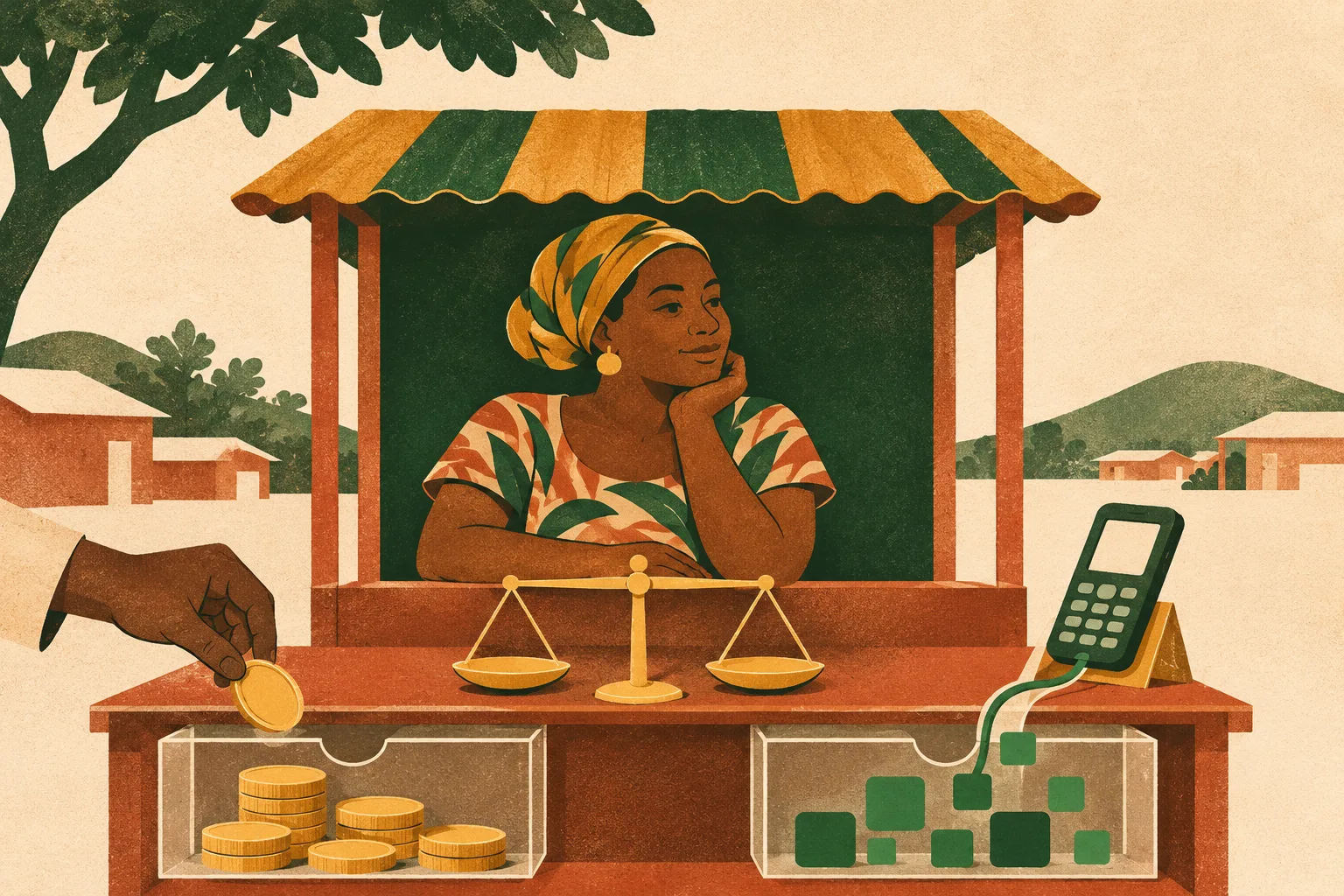
Suppose a recipient elsewhere wants KES 1,000 in cash, but the second agent has only KES 800 available. The shortfall is KES 200. A valid wallet balance cannot manufacture the missing banknotes. This is a cash-availability problem, distinct from a failed transfer. It is why “payment completed” and “cash collected” should be separate steps in a user’s own records.
Does a cash-backed wallet mean cash is available everywhere?
No. The founding paper describes the early arrangement under which customer electronic value was matched by funds held at Commercial Bank of Africa. That is a historical account of backing at system level. It does not say that every agent held enough banknotes to meet every possible withdrawal.
There are two different questions: what supports the aggregate wallet balances, and what a particular outlet can pay at a particular moment. The example above answers only the second. Neither the historical backing arrangement nor our hypothetical ledger establishes current deposit insurance, reimbursement rights or the legal treatment of funds in every country.
For that reason, this article is not a recommendation to treat every mobile-money wallet like a bank deposit. Before keeping a significant balance, read the applicable provider’s terms and the local rules on safeguarding, access and complaints. Do not import protection claims from another country or from a 2007 paper.
How much can sending KES 1,000 really cost?
Use a complete route, rather than compare only the first visible fee. For this calculation alone, assume a KES 20 sending fee, a KES 30 cash-out fee and no other charges. These are hypothetical teaching inputs, not M-Pesa tariffs.
The sender pays KES 1,020 to credit the recipient with KES 1,000. If the recipient uses that balance to pay a KES 30 withdrawal fee and collect KES 970 in cash, total route fees are KES 50. Measured against the intended KES 1,000 principal, that is 50 ÷ 1,000 = 5%. Measured against the sender’s KES 1,020 outlay, it is 50 ÷ 1,020 = 4.90%.
Both percentages are arithmetically correct; their denominators differ. The result is not that one percentage is honest and the other false. A comparison becomes misleading when the denominator changes without saying so. Also notice that withdrawing KES 1,000 plus a KES 30 fee would require KES 1,030, which this example’s recipient does not have.
Our transfer cost calculator uses the same discipline: write down who pays each charge and what arrives at the end. If a transfer involves different currencies, keep conversion costs separate from explicit service fees. Use the payment-fee comparison checklist when comparing complete payment routes.
Does a large transaction total measure new wealth?
Consider one KES 1,000 balance moving from person A to person B, then B to C, then C to D. Adding the three transfers gives KES 3,000 of gross transaction value. It does not mean that KES 3,000 of additional wallet balances appeared. It also does not measure the value added by the goods or services behind those payments.
This is an original counting example, not a claim about M-Pesa’s reported volumes. The transfers might support useful economic activity. The point is that the payment total alone does not establish how much. A payment-volume figure and a GDP figure answer different questions; a large ratio between them is not proof that a payment provider created that share of the economy.
When reading a headline, ask whether it counts transactions, their total value, customers, active accounts or company revenue. Then check the period and the country. This article deliberately avoids combining old adoption statistics with a 2026 label.
What changed when smartphones arrived?
The 2021 SuperApp milestone is a change in access and presentation. It should not erase the earlier history. A richer interface can sit above a payment system whose underlying tasks still include identifying the recipient, recording value and enabling spending or cash collection.
For a reader, the continuity is more useful than the marketing category. An app screen does not itself establish the final fee, cash availability or the protection attached to a balance. Those remain separate checks. The local version of a service may also differ: a translated article does not establish that the same product is available in your country.
The next step in M-Pesa’s story is therefore not simply “phones became smarter.” It is deciding which new services improve an actual payment journey and which add a separate obligation, such as credit. Assess a loan on its own terms; do not treat it as an automatic feature of holding electronic money.
Which mistakes make the story misleading?
- Calling the original service an internet app skips the SIM-and-SMS access model.
- Calling it a system without banks confuses the customer’s experience with the backing infrastructure.
- Treating successful transfer confirmation as proof of cash collection ignores the agent’s available banknotes.
- Quoting historical customer numbers as current data conceals the observation date.
- Using our illustrative KES 20 and KES 30 fees as a live price quote changes an example into misinformation.
Payment convenience also changes how easy it is to move money into risky activities. A working payment rail says nothing about the safety of a casino, investment or recipient using it. Keep money needed for ordinary living outside speculative spending, and assess the underlying transaction separately from the convenience of paying.
What should you check before using a mobile-money service?
- Confirm the country, provider and current eligibility rules. This is a Kenyan history, not an international registration guide.
- Price the complete route: funding, sending, conversion if relevant, and cash collection or spending.
- Confirm recipient details before authorising; keep your PIN private.
- Establish where cash can be collected and ask about availability when that matters.
- Save the transaction reference and distinguish a completed transfer from a completed withdrawal.
- Read current support, complaints and safeguarding terms before leaving a substantial balance.
For a record-keeping workflow rather than a history, use the Kenya mobile-money complaint-records guide. It addresses a different task: assembling evidence when something needs to be traced.
Questions readers ask about M-Pesa
What is the history of M-PESA?
A microfinance-repayment pilot began in late 2005 before the Kenyan commercial launch on 6 March 2007. The early accounts describe demand for transfers between people; smartphone access followed much later, including the 2021 SuperApp. The dated timeline above separates those stages.
What is M-PESA and how does it work?
It is a mobile-money service connecting a phone-accessible balance with payments and cash-in/cash-out agents. In the original model, a basic phone could access it through a SIM menu and SMS rather than a mobile-data connection. Current features and access conditions depend on the provider and market.
How does M-PESA make profit?
Customer service fees can contribute revenue, but revenue is not profit. FSD Kenya’s historical account also describes commissions paid to agents, which illustrates a cost of providing the service. Our worked fees are hypothetical, and these sources do not establish today’s profit margin or the treatment of interest on safeguarded funds.
Sources and further reading
Fact-checked: . External sources open in a new tab.
- M-PESA: Mobile Money for the “Unbanked” (2007), Nick Hughes and Susie Lonie, pp. 63–81Innovations 2(1–2), DOI 10.1162/itgg.2007.2.1-2.63
- An overview of M-PESA (12 August 2015), Tamara CookFSD Kenya
- M-Pesa: creating the leading mobile money service (2017), Michael JosephVodafone
- M-Pesa marks 15 years (2022)Vodafone