Independent guide · Payments
What to record if an ATM takes your money but pays no (or only some) cash
Practical UK checklist to collect the evidence your bank and the Financial Ombudsman will expect when an ATM debits your account but dispenses no or only part of the cash. Includes a worked example and safe next steps.
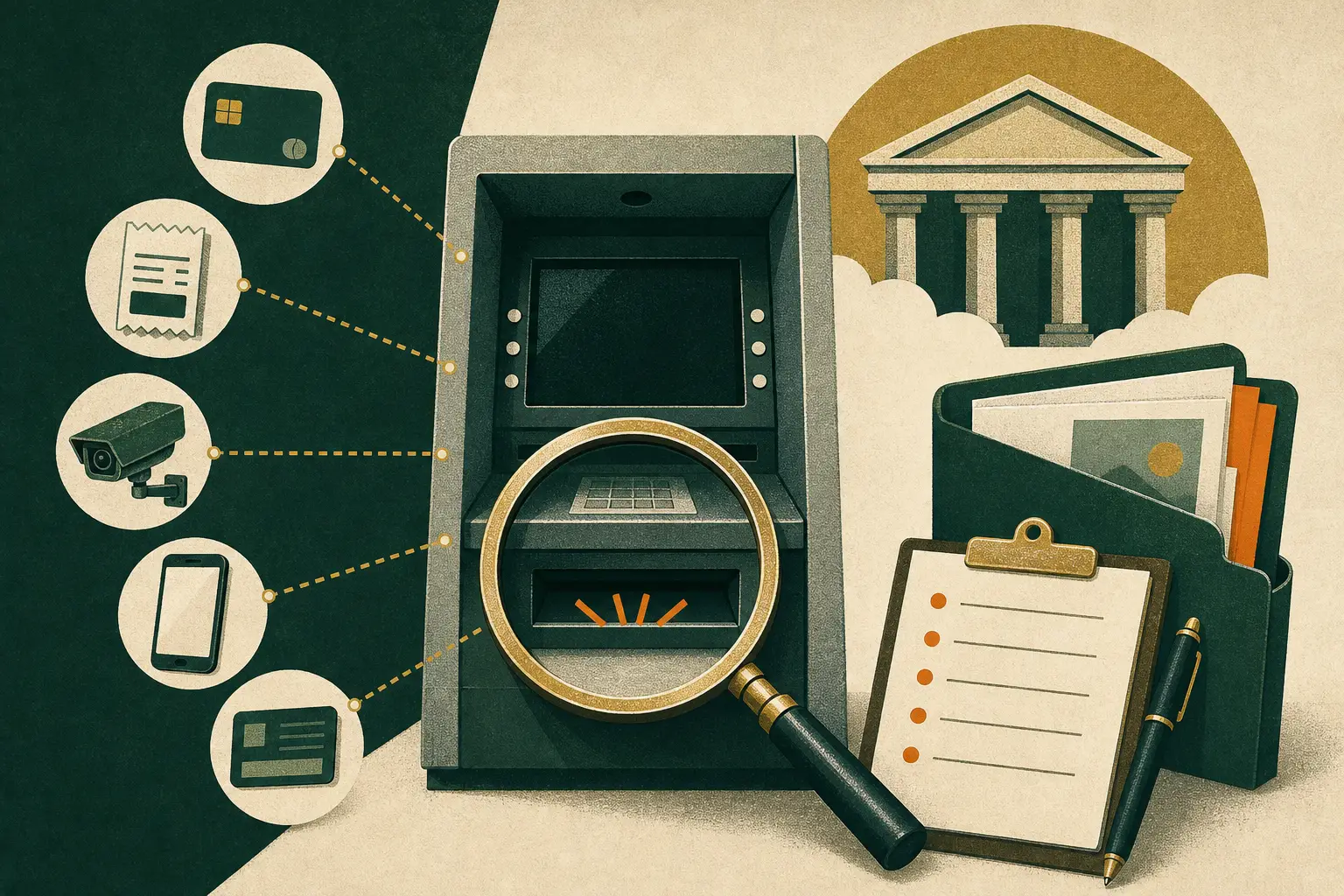
Why this matters
If an ATM debits your account but gives no or partial cash, contact your bank immediately and provide a clear audit trail (time, ATM ID/location, requested/received/debited amounts, receipt/screenshots).
What happened — and who you should contact first
If an ATM debits your account but gives no cash or only part of the cash you requested, your first action must be to contact your bank or card issuer. UK industry guidance (LINK) instructs customers to report the problem to their bank because the bank is the party that raises a formal investigation on your behalf.
Use a trusted channel: the phone number on the back of your card, your bank’s official website, your bank’s secure app or a branch. Avoid posting account details or PINs on social media or in public forums.
- Banks raise formal investigations through industry processes (LINK/ATM operator coordination).
- Contacting the issuing bank promptly preserves the strongest evidence trail.
Evidence to collect immediately
Gather an audit trail you can hand to your bank. The Financial Ombudsman assesses disputes using evidence from you and the firm; stronger records improve the investigation’s clarity and speed.
Focus on objective, time‑stamped items the bank can match to terminal logs: exact time, ATM identifier, the amounts involved, receipts and screenshots.
- ATM identifier or terminal number (visible on machine or receipt) — photograph if needed.
- Exact date and local time of the attempted withdrawal; match this to your bank app’s posting time.
How banks investigate and why your evidence matters
Banks will compare their transaction posting with the ATM’s terminal audit/logs and the LINK network records. Because multiple parties (issuer, ATM operator, cash manager) can be involved, the investigation often requires correlating timestamps and terminal IDs.
Your checklist helps the bank identify the precise terminal audit to review and speeds up the inquiry. Without clear timestamps or a terminal ID, an investigation may take longer or be less conclusive.
- Terminal audit records show whether cash was physically dispensed; your evidence links your card record to that audit.
- Receipts and screenshots often contain terminal IDs and timestamps — keep them.
Immediate safety steps and how to report
Do not share your PIN with anyone — banks and investigators never need your PIN to investigate a dispensing error. If anyone asks for your PIN, treat that as potential fraud and contact your bank immediately.
Do not make repeated rapid attempts at the ATM — that can create more transactions and complicate your evidence. Photograph the machine and the screen, keep any printed receipt, and then contact your bank via a trusted channel.
- Use official contact numbers or your secure banking app to report the issue.
- Ask the bank for a reference number and record the name of any agent you speak to.
Practical checklist
- Bank/card issuer name and official contact method (phone/app/branch).
- Exact date and local time of the attempted withdrawal.
- ATM location (address or shop/forecourt name) and ATM identifier/terminal number (photograph the machine if not visible).
- Requested amount, cash actually received (write exact amount or ‘none’), and amount shown debited on your account (screenshot/photo).
- Keep the ATM receipt or photograph the screen and receipt if no printout is given.
- Record any on‑screen messages, machine behaviour and names/contact of any witnesses or staff you informed.
- Log every contact with your bank (date/time/method/agent name/reference number) and what the bank said it would do.
- List separately any fees or charges you incur (ATM fee, overdraft fees) with dates and amounts.
Sources and further reading
Fact-checked: . External sources open in a new tab.
- Help CentreLINK (UK ATM network)
- Banking and payments — consumers: complaints and disputesFinancial Ombudsman Service
- Access to cash — frequently asked questionsPayment Systems Regulator (PSR)