Independent guide · Casino
Roulette probabilities and house edge: single‑zero vs double‑zero vs triple‑zero
Clear, evidence‑based comparison of probabilities and house edge on single‑zero (European), double‑zero (American) and triple‑zero roulette wheels, with worked dollar examples and practical limits.
Why this matters
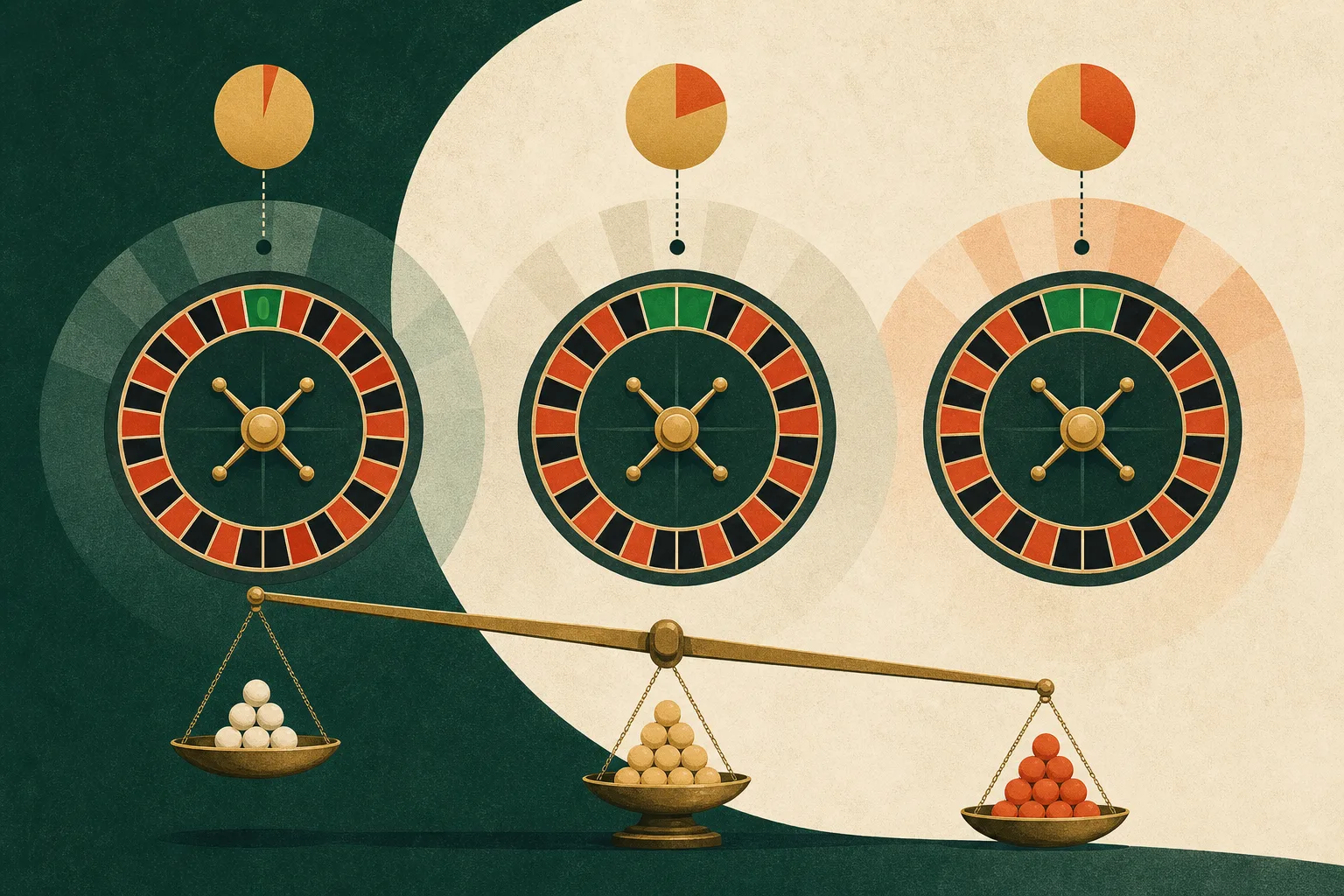
With standard payouts unchanged, the house edge equals z/(36+z) where z is the number of zero pockets: single‑zero ≈ 2.70%, double‑zero ≈ 5.26%, triple‑zero ≈ 7.69%.
How the math works: pockets, payouts and the z/(36+z) formula
A standard numbered roulette layout has 36 payout‑number pockets. Casinos pay straight‑up wins as if there were 36 non‑zero outcomes (35:1 plus return of stake). When the wheel includes z green zero pockets the true number of outcomes becomes 36 + z. If payouts remain the unchanged standard amounts, the house edge on a non‑special bet is z/(36+z).
This formula follows directly from expected‑value arithmetic: a $1 straight‑up bet returns 36/(36+z) on average, so the expected loss (house edge) equals 1 − 36/(36+z) = z/(36+z). It applies to every ordinary bet type provided the payout table is unchanged.
- Pockets = 36 + z, where z = number of zeros (1, 2, or 3).
- House edge = z/(36+z) for standard payouts.
- Formula assumes unchanged 35:1 straight‑up and other standard payouts.
- Each spin is independent; house edge is a long‑run expected loss.
Single‑zero, double‑zero and triple‑zero: the numbers
Single‑zero (European/French) wheels have 37 pockets (1–36 + 0) and a baseline house edge of 1/37 ≈ 2.7027% when no special rules apply.
Double‑zero (American) wheels have 38 pockets (1–36 + 0 and 00) and an edge of 2/38 = 1/19 ≈ 5.2632%. Triple‑zero variants (1–36 + 0, 00, 000) have 39 pockets and, with standard payouts, an edge of 3/39 = 1/13 ≈ 7.6923%.
- Single‑zero: 37 pockets → house edge ≈ 2.70%.
- Double‑zero: 38 pockets → house edge ≈ 5.26%.
- Triple‑zero: 39 pockets → house edge ≈ 7.69% (if payouts unchanged).
- Triple‑zero is less common and often proprietary or novelty.
Worked examples: per‑spin and short‑session expected loss
Example (single $1 straight‑up bet, pays 35:1): single‑zero win prob = 1/37; expected return = 36/37 ≈ $0.972973; expected loss ≈ $0.027027 per $1 bet (2.7027%).
The same $1 straight‑up on double‑zero returns 36/38 ≈ $0.947368 (loss ≈ $0.052632). On triple‑zero it returns 36/39 ≈ $0.923077 (loss ≈ $0.076923). Scale these by bet size and spins (e.g., 100 spins at $10 each gives expected losses ≈ $27.03, $52.63, $76.92 respectively).
- Single $1 bet loss: ≈ $0.02703 (single‑zero).
- Single $1 bet loss: ≈ $0.05263 (double‑zero).
- Single $1 bet loss: ≈ $0.07692 (triple‑zero).
- 100 spins × $10 example: losses ≈ $27.03 / $52.63 / $76.92.
Limitations, rule variants and responsible use
Some tables use special dealer rules that alter effective edge on certain bets. 'La partage' or 'en prison' on European/French tables halve the house edge on even‑money bets; these table‑specific rules change outcomes for affected bets but do not alter the baseline z/(36+z) unless applied.
Casinos may also offer non‑standard side bets, electronic variants, or adjusted payouts—each requires separate evaluation. Triple‑zero wheels are less standard and may use proprietary branding or variant rules; always confirm the exact table rules before play. Remember that house edge describes long‑run average loss, not a short‑term guarantee: variance is high on single‑number bets.
- En prison / la partage can reduce edge on even‑money bets (table‑specific).
- Non‑standard payouts or side bets change expected value; verify rules.
- Triple‑zero availability and exact rules vary by operator/jurisdiction.
- House edge is a long‑run expectation; short sessions vary widely.
Practical checklist
- Confirm the wheel type at the table (1‑zero, 2‑zero, or 3‑zero) before betting.
- Check table rules for 'la partage' or 'en prison' if you plan even‑money bets.
- Convert percentage house edge into dollars for your typical bet size and session length.
- Set loss limits and a fixed bet sizing rule to manage bankroll exposure.
Sources and further reading
Fact-checked: . External sources open in a new tab.
- Roulette calculator and explanationProvenlyFair
- Roulette: basics and wheel variantsWizard of Odds
- IGT technical/regulatory filing (includes triple‑zero reference)New York State Gaming Commission (IGT document)